
The "Polar Gentleman" in a Scout’s Uniform: The Mystery of the British Antarctic Territory Stamp
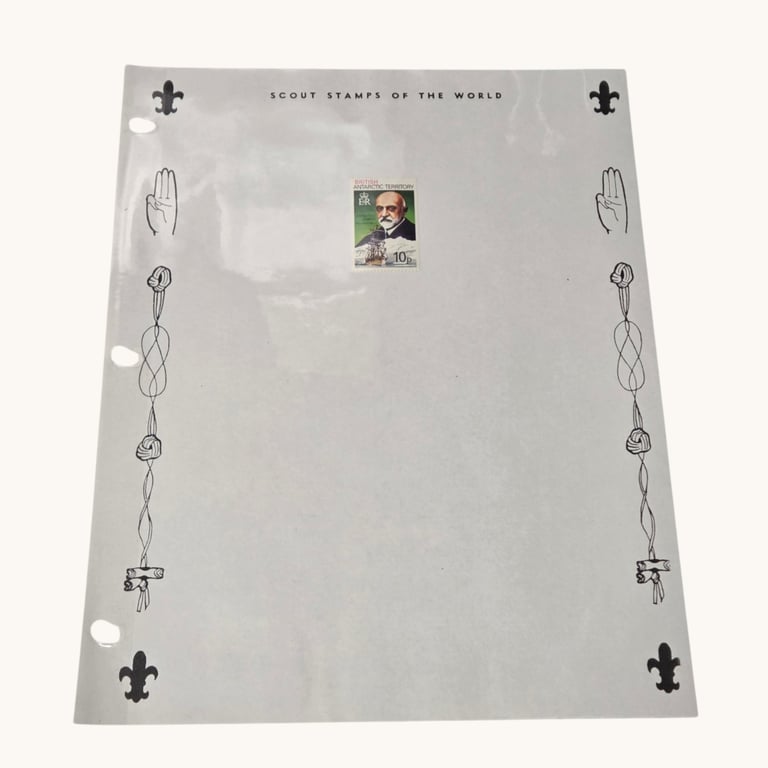
Tucked away in the "Scout Stamps" global collection is a curious piece of postal history: a stamp from the British Antarctic Territory featuring a rugged Frenchman named Jean-Baptiste Charcot and his ship, the Pourquoi Pas?
COLLECTIBLES
Ignacio A.
4/2/20263 min read
The "Polar Gentleman" in a Scout’s Uniform: The Mystery of the British Antarctic Territory Stamp
When we think of the Boy Scouts, we often picture campfire circles, merit badges, and local community service. We don't immediately think of the frozen, desolate stretches of the Antarctic. Yet, tucked away in the "Scout Stamps" global collection is a curious piece of postal history: a stamp from the British Antarctic Territory featuring a rugged Frenchman named Jean-Baptiste Charcot and his ship, the Pourquoi Pas?
For the discerning collector or the home historian, this single stamp represents a collision of three worlds: the "Heroic Age" of polar exploration, the birth of a global youth movement, and the spirit of scientific inquiry.
A Vessel of Curiosity: The Pourquoi Pas?
The centerpiece of the stamp is often the ship itself—the Pourquoi Pas? (translated as "Why Not?"). The name alone serves as a masterclass in the explorer’s mindset. As a child, Jean-Baptiste Charcot famously gave this name to a small, homemade boat that promptly sank. Rather than abandoning the name, he adopted it for four successive vessels, culminating in the three-masted barque pictured on your stamp.
The Pourquoi Pas? IV wasn't just a transport ship; it was a floating laboratory. Equipped with three different laboratories and a library of over 1,500 volumes, it was designed to withstand the crushing ice of the Graham Land coast. Between 1908 and 1910, Charcot used this vessel to map over 1,250 miles of newly discovered coastline. In the world of maritime decor and history, the silhouette of the Pourquoi Pas? is iconic—a symbol of the transition from wooden sailing ships to modern scientific research vessels.
The Man Behind the Stamp: Dr. Jean-Baptiste Charcot
Charcot was an anomaly among polar explorers. While his contemporaries often treated the Antarctic as a race track for national glory (the race to the Pole), Charcot was a man of science and medicine. He was dubbed the "Polar Gentleman" by his British rival, Robert Falcon Scott, because of his unwavering ethics and his habit of maintaining high standards of conduct even in the harshest conditions.
But why does a Frenchman appear on a British Antarctic Territory stamp specifically dedicated to Scouting?
The Scouting Connection: Building the Éclaireurs de France
The answer lies in Charcot’s life back in Europe. In 1911, just a year after returning from his second major Antarctic expedition, Charcot helped found the Éclaireurs de France, the first non-religious scouting organization in France. He didn't just lend his name to the masthead; he served as its President for nearly 15 years.
Charcot believed that the rigors of exploration—the need for self-reliance, physical fitness, and observation—were the exact qualities the Scout movement aimed to instill in young people. To him, a Scout was a "miniature explorer." When the British Antarctic Territory issued this stamp (part of a 1979/1980 series), they weren't just honoring a navigator; they were honoring a man who spent his life ensuring that the spirit of the "Heroic Age" lived on through the next generation of Scouts.
Why This Stamp Matters to Collectors Today
For those of us who curate unique items for our homes and libraries, stamps like these are more than just paper—they are "micro-artifacts." In an eBay store filled with hundreds of items, this specific British Antarctic Territory lot stands out for several reasons:
Topical Crossover: It appeals to "Topical" collectors of three distinct niches: Scouting, Ships/Maritime History, and Polar Exploration.
The "Gentleman Explorer" Aesthetic: The imagery of the stamp fits perfectly into the "Dark Academia" or "Vintage Nautical" home decor trends. It’s the kind of item that, when framed, sparks a conversation about a man who asked "Why Not?" when faced with the impossible.
Rarity of Narrative: Most Scout stamps feature Robert Baden-Powell or local troops. A stamp featuring a French explorer on British-claimed soil is a rare nod to the international cooperation that has defined both Scouting and Antarctic research for over a century.
The Final Voyage
Tragically, Charcot’s story ended as it began—with the Pourquoi Pas?. In 1936, at the age of 69, Charcot and his crew were caught in a violent storm off the coast of Iceland. The ship was wrecked on the reefs of Alftanes. Of the 41 men on board, only one survived. Charcot was last seen on the bridge, true to his gentlemanly nature, ensuring his crew was taken care of until the very end.
Conclusion: More Than Just a "Scout Stamp"
When you look at this one-page entry in the global Scout Stamps collection, you aren't just looking at a piece of postage. You are looking at the legacy of a man who believed that curiosity was the greatest human trait. Whether you are a veteran philatelist or someone looking to add a piece of history to your home office, the story of Jean-Baptiste Charcot reminds us that the reach of the Boy Scouts is as vast as the Antarctic ice itself.
The Pourquoi Pas? reminds us to ask "Why not?" in our own lives—whether that's starting a new collection, exploring a new hobby, or simply learning the story behind a single, curious stamp.
Mailing Address: 7750 N. Kendall Dr. #283, Miami, FL 33156
© 2026. All rights reserved. Ayalcom, LLC dba SHOPIGGSTER26