
Explore Scout Stamps: The Art of Stamp Collecting
Discover the fascinating world of stamp collecting with our unique scout stamps collection. Uncover the rich history behind global stamps that capture the essence of vanished nations and preserve their legacy.
COLLECTIBLES
Ignacio A. | Iggster26
12/12/20256 min read


Where Are Abkhazia, Kathiri, and Mahra? A Deep Dive into the 'A' Countries of the Historic 16-Volume Scout Stamp Collection
The world of stamp collecting often serves as a beautiful, miniature atlas of history, preserving the names and images of nations that have long since vanished from modern maps. Our newly acquired collection, Scout Stamps: A Global Collection, is perhaps the finest example of this concept we’ve encountered.
Archived meticulously across sixteen (16) volumes, this monumental collection is organized in strict alphabetical order by country. This means that Volume 1 is dedicated exclusively to countries beginning with the letter 'A', making it a treasure trove of philatelic history from around the globe. Dating back to the early 1940s, and containing stamps focused primarily on the Boy Scouts movement, the sheer scale, organization, and "very fine" condition of this archive suggest it was the life's work of a dedicated philatelic historian.
We have begun the process of releasing this treasury to the public, starting with the pages of Volume 1. The initial response has been great, with two 24-page lots (Vol.1 Lot 5 & Lot 6) selling out almost immediately.
But what makes these opening pages so compelling?
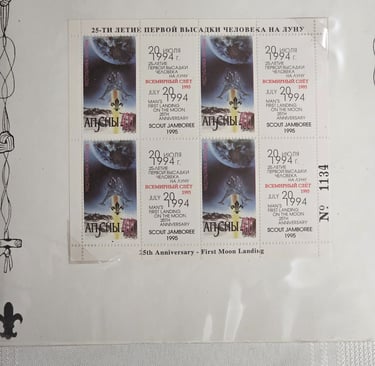
Look closely at the names in the current listings, and you’ll find a series of countries that challenge even the keenest historian: Kathiri, Mahra, Qu’aiti, and Abkhazia. These aren't just obscure destinations; they are political entities whose very existence was often brief and whose official Scouting history is now primarily preserved on these delicate, colorful stamps—all starting with the letter 'A' in the original curator's detailed alphabetical listing.
This first look will take you on a journey through Volume 1 Lot 1, revealing why this collection is not just a gathering of postal history, but a fascinating archive of global Scouting during a period of intense political change.
The Transient Kingdoms of South Arabia: A Collector's Obsession
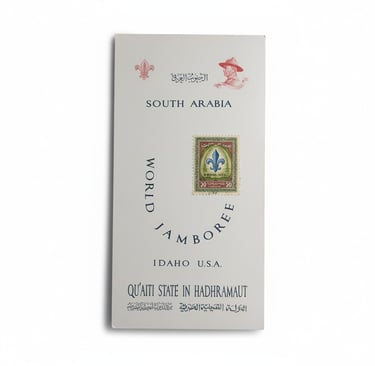
Perhaps the most historically intriguing stamps in Volume 1 Lot 1 come from the former Federation of South Arabia—an area that is now modern-day Yemen. The collection contains colorful issues from the Aden Protectorate, specifically the individual sultanates within it.
The very presence of these stamps in the collection highlights a fascinating intersection of philately, history, and the global spread of Scouting.
Kathiri, Mahra, and Qu’aiti: Rulers, Rovers, and Revenue
The stamps of Kathiri, Mahra, and Qu’aiti were issued by sultanates that maintained varying degrees of independence under British protection until the mid-1960s. These stamps often fall into a category known as "Dunes Issues" or "Sand Dunes" issues, as they were often produced with the primary intention of being sold to stamp collectors worldwide to generate revenue, rather than facilitating a robust local postal system.
However, the fact that the original curator of the Scout Stamps collection diligently acquired and preserved these specific Scouting-themed issues from these entities tells a powerful story:
Philatelic Dedication: It shows the collector was determined to achieve a truly "Global Collection," pursuing issues even from the most short-lived or philatelically-focused territories. The collector included these in their 'A' section, adhering strictly to the recognized name of the issuing authority.
Scouting’s Reach: The issuance of a stamp, even for revenue, required official approval and acknowledged the existence of the Scouting movement within that territory, validating its international relevance.
Throughout the collection you will find stunning examples of these issues. Look closely at the designs—they showcase local landscapes, portraits of rulers, and, most importantly, the symbols and activities of the Boy Scouts, binding a global movement to a specific local context.
Abkhazia: A Political Anomaly
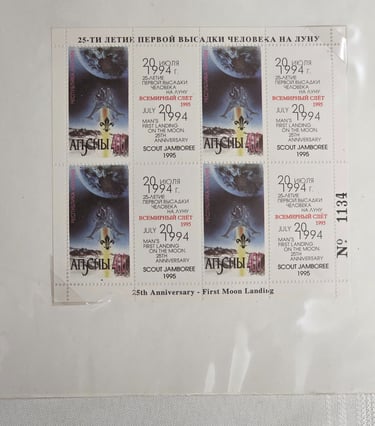
While the Arabian stamps represent transient kingdoms, the inclusion of Abkhazia represents a different kind of geopolitical complexity. Abkhazia, a territory on the eastern coast of the Black Sea, has a long and complicated history, most recently involving contested sovereignty from Georgia.
The Scouting stamps found here likely fall into one of two categories that fascinate collectors:
Local Issues: Stamps produced for internal use or by the de facto government during times of political instability.
Cinderella Stamps: These are labels that resemble postage stamps but are not valid for postage by a national postal administration (often produced for political statements or fundraising).
The original collector’s decision to include these "A" anomalies, regardless of their official postal status, underscores the collection's focus: documenting the image and history of Scouting wherever it appeared on a printed label.
Afghanistan: A Stable Endorsement
Volume 1 Lot 1 is not, however, only defined by its rare and brief issues. It is grounded by a major global nation starting with the letter 'A' that provides a stable chronological anchor for the collection.
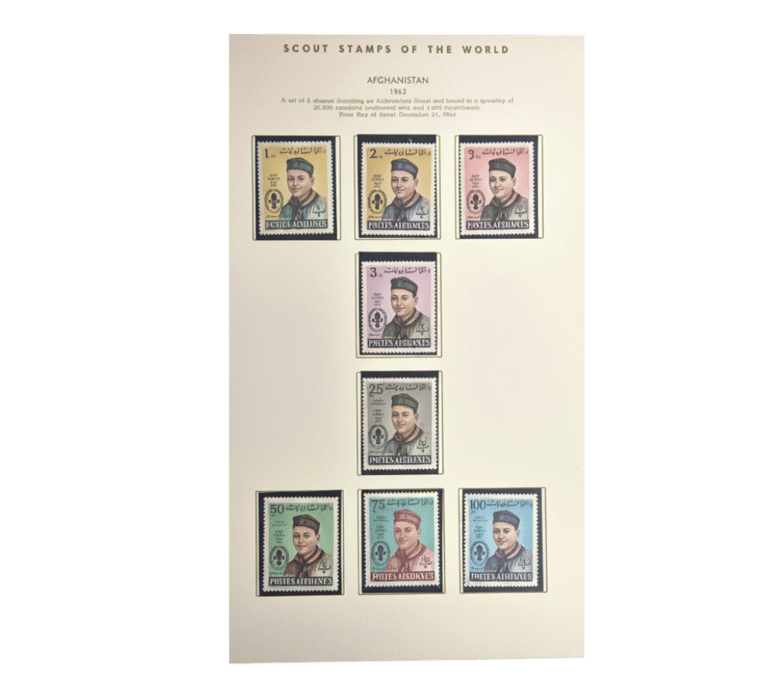
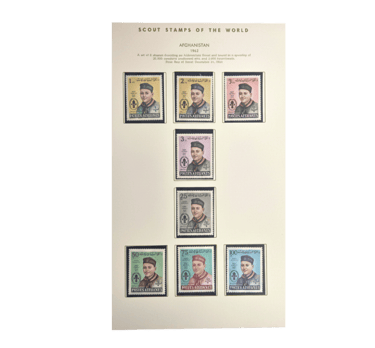
The stamps of Afghanistan, for instance, offer a sense of stable, official national endorsement for the movement. Scouting in Afghanistan has a long, interrupted history, officially beginning in the 1930s. The stamps from Afghanistan in this collection are generally unambiguous national issues, confirming the country’s participation in the global brotherhood of Scouting during the mid-20th century. The Afghan stamps often depict Jamboree events, national symbols alongside the fleur-de-lis, or portraits of the reigning monarch (before the Republic era) endorsing the organization.
When you compare in Volume 1 Lot 1—between the solid history of Afghanistan and the transient history of the South Arabian Sultanates—gives the entire volume a powerful historical tension, all confined to the first letter of the alphabet.
Understanding ‘Very Fine’ Condition
As the current custodian of this vast collection, I've spent considerable time assessing its condition. It is my personal opinion that, considering the age and size, the vast majority of the stamps qualify as "Very Fine" (VF).
For non-experts, understanding the term "Very Fine" is crucial when purchasing vintage collections:
Centering: A Very Fine stamp generally has its design well-centered, though minor shifts are allowed. The stamps in this archive are consistently well-cut and centered.
Perforations: The perforations are intact, distinct, and without missing teeth, which is a common flaw in stamps from the 1940s and 50s.
Color and Gum: The colors remain vibrant, protected by decades within the archival pages. Many of the unused stamps retain their original gum, though this gum may show traces of hinging—a classic, acceptable archival practice for collections dating to this period.
The condition is a direct testament to the original curator’s rigorous archival standards. Each page shows methodical placement and careful handling, ensuring that the history preserved on the stamp itself is not marred by damage or neglect.
Origin and History: The Alphabetical Archival Method
The physical structure of this collection is a major selling point. It is not a shoebox of loose stamps; it is a meticulous, 16-volume philatelic library.
The original owner’s methodology, organizing the collection strictly by alphabetical country name, showcases an obsessive commitment to completeness. They didn't just collect stamps; they curated an encyclopedia. The fact that 'A' required an entire large notebook underscores the depth of this dedication, encompassing everything from major powers to minor sultanates.
In reviewing the pages across Volume 1, there are subtle clues suggesting the collection may have passed through different hands: minor changes in the type of hinge used, different styles of handwritten notes on the page margins, or shifts in the volume of content dedicated to a single country. This provenance—the history of ownership—only adds to the mystique and inherent value, suggesting that multiple passionate collectors contributed to its magnitude over time.
When you purchase a 24-page lot, you are not just getting stamps; you are inheriting the archival pages themselves, complete with the collector's handwritten organizational markers, making the lot a historical artifact in its own right.
Shop the Collection Now



Mailing Address: 7750 N. Kendall Dr. #283, Miami, FL 33156
© 2026. All rights reserved. Ayalcom, LLC dba SHOPIGGSTER26